You hear a sentence one time. A beep sounds. You have eight seconds to say it back, and there is no replay button and no text on the screen to lean on. That is the entire Listen and Repeat task, repeated seven times with sentences that keep getting longer.1
It sounds almost trivial, which is exactly why strong English speakers lose points on it. The people who struggle most are usually fluent test-takers who have never trained the one thing this task measures: how much spoken English you can hold in your head and reproduce under a clock. This guide walks through what the task looks like on test day, the way the AI scores it, the moves that protect your score on a sentence you only half-caught, and the drills that build the underlying skill in two to three weeks.
Listen and Repeat is the first of two tasks in the redesigned TOEFL Speaking section, which ETS launched on January 21, 2026 alongside a shorter, more conversational format.2 If you want the whole-exam picture first, read the TOEFL 2026 test format guide; this page goes deep on just this task.
What you see on test day
Speaking comes last, and the whole section now runs about eight minutes across two tasks and eleven items total.3 The first seven of those items are Listen and Repeat; the remaining four belong to the Take an Interview task.4
For each item you see a simple context picture and hear one sentence read aloud. No text appears on screen, and the audio never repeats.1 The seven sentences are not random; they all belong to one scenario, such as a campus tour or a set of step-by-step instructions, so the picture gives you something to attach each sentence to.5 They start short, around five or six words, and grow to the upper teens by the last two, picking up extra clauses and harder vocabulary as they go.6 After each sentence a beep tells you to start, and recording begins on its own. Your speaking window matches the length: eight seconds for sentences one and two, ten for three through five, and twelve for the last two.1
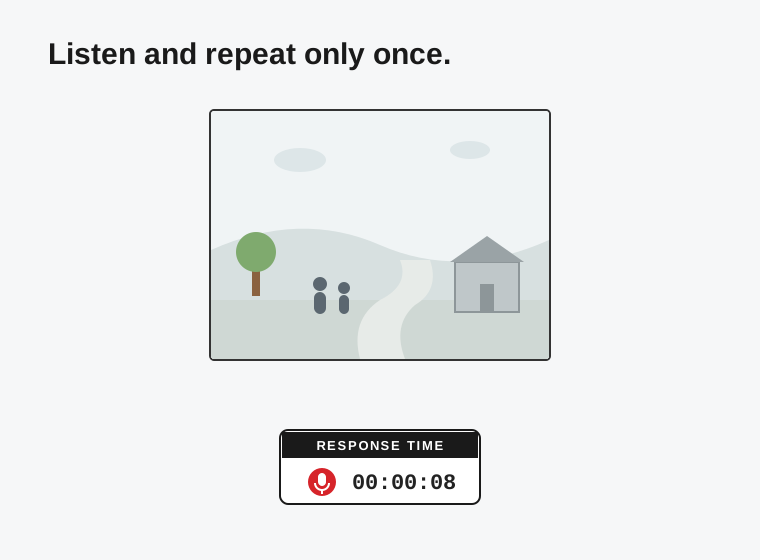
The single biggest adjustment from the old test is that you get no preparation time at all, on either Speaking task.4 The legacy iBT gave you fifteen to thirty seconds to plan a Speaking response. That cushion is gone, so the task is genuinely spontaneous from the first beep.7
What Listen and Repeat actually tests
The surface skill is repetition. The real skill underneath is your phonological memory, the part of the mind that briefly stores the sounds of what you just heard. Psychologists call it the phonological loop. The store itself is passive: the sounds fade on their own within about two seconds unless you keep them alive, and the way you keep them alive is by repeating them silently to yourself, which is something you do, not something the brain does for you automatically. A sentence of five or six words fits inside that window easily; a sentence of sixteen does not. So the task is really checking whether you can group the words into a few meaningful chunks and say them back quickly, while the sounds are still fresh.
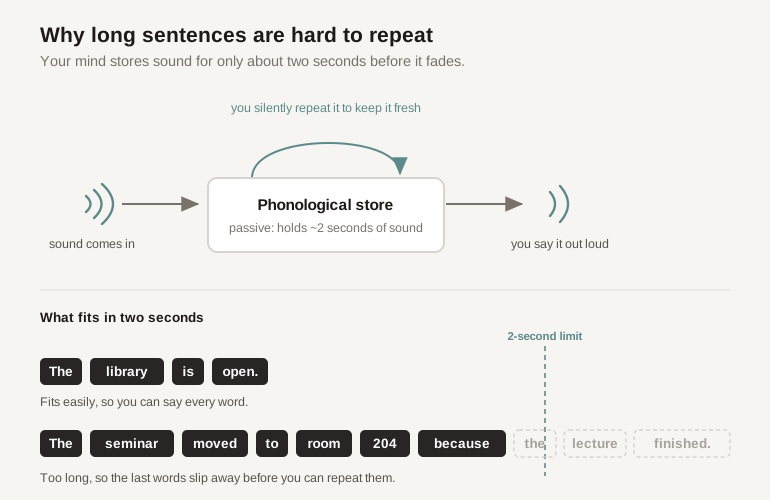
This is where the task gets interesting, because that two-second window barely stretches no matter how hard you train. What you can change is how much you fit inside it. Repeating raw sounds in your head holds a handful of words and then breaks down, so the trick is to group the words into a few meaning-chunks, where "the library will close on Friday" travels as one unit instead of six. A chunk fits in one slot because your long-term knowledge of English already holds that pattern, so you keep a pointer to something familiar rather than six separate sounds. That is how you repeat a sixteen-word sentence that should overflow a two-second store: most of it is rebuilt from language you already know, not held as fresh audio. So chunking does let you recall well past two seconds of speech, but not by enlarging the store itself, which is also why someone hearing a language they do not know hits the raw limit almost at once: they have nothing to chunk with. Practice makes the chunking faster: the more familiar the patterns of English sound to you, the quicker you group them and the more you keep. That is the real reason the drills later in this guide work, and it is why this task rewards listening for meaning over memorizing strings of syllables.
Pronunciation is the second half of what it measures. The scorer has to recognize every word you say, so your sounds and your sentence rhythm need to come close to the recording: the nearer your delivery sits to that model, the higher you score.6 A response with all the right words can still lose points if it comes out flat, choppy, or mumbled, because parts of it are hard to make out on playback.8
This is why fluent speakers get surprised. They have the vocabulary and the grammar already, so nothing about the sentences is hard to understand. What trips them is the memory load and the absence of any planning time, two things ordinary conversation never tests.
How TOEFL Listen and Repeat is scored
Each of the seven sentences is scored from 0 to 5, and the item scores add up to a raw Speaking total across both Speaking tasks that ETS then converts into the 1 to 6 band on your report, in half-point steps.93
A machine does the first-pass scoring. ETS uses its own automated engines, SpeechRater for speech and e-rater for writing, as the first scorer on every 2026 Speaking and Writing response.109 SpeechRater runs speech recognition on your audio to build a transcript, then pulls a large set of acoustic and linguistic features from it, including pronunciation, rhythm, pausing, speaking rate, and word accuracy, and feeds them to a model trained on thousands of human-scored responses.119 A human rater only looks at your answer if the engine flags it, for instance when it suspects a memorized response or cannot match your speech to the prompt.9
For Listen and Repeat, two things matter most: how much of the sentence you get back accurately, and how clearly you say it.8 The published rubrics from the major prep companies agree on what each band needs:8112
| Score | What the response looks like |
|---|---|
| 5 | An exact, fully intelligible repetition. Every word is present, in order, and easy to understand. |
| 4 | The meaning stays intact but the repetition is not exact: usually a dropped function word like "a" or "the," a small substitution, or two words swapped. |
| 3 | Complete enough to follow, but content words are missed or changed so the meaning shifts, or parts are hard to understand. |
| 2 | Fragmented, with important content missing and delivery that is hesitant or unclear. |
| 1 | Only a few recognizable words, with the sentence not really preserved. |
| 0 | No response, or speech that is unintelligible or unrelated. |
Two boundaries decide your score. You only reach a 5 with an exact repetition, so perfection is the price of the top band.8 Dropping below a 4 takes a content word, not a function word: lose "the" and you usually stay at a 4, but lose "projector" or "Friday" and the meaning changes.12 So aim your attention at the nouns and verbs, not the small grammar words.
Your accent is not penalized: a clear, complete answer scores well even with a strong accent, while slurred or swallowed words hurt because the engine cannot make them out.8 Hesitation works against you too, so a long silence before you start, a false start, or a restart partway through all read as fluency problems.1
A step-by-step strategy for each sentence
The whole game is the four or five seconds between the end of the audio and the moment you start talking. Here is how to use them.
Listen for meaning, not for words
Trying to memorize the sentence word by word is the fastest way to lose it. Listen the way you would to a friend giving you directions: catch the meaning and the shape. If you know the sentence means "the seminar moved to room 204 because the projector broke," you will rebuild the exact words far more reliably than if you tried to bank fourteen loose sounds. On the short early sentences, quietly echoing the words in your head as you hear them helps and keeps them fresh. On the long ones it backfires, because while you are repeating the opening you stop hearing the end, so let meaning carry the longer sentences.
Chunk by stress group
Native sentences come in beats. "The library will close // two hours early // on Friday" is three chunks, not seven words. Hearing the sentence as a small number of stress groups cuts the memory load dramatically, because you are holding three units instead of seven. This is the single technique that separates people who can repeat the long sentences from people who fall apart on sentence six.
Start on the beep, not after you have rehearsed
Do not wait until you feel ready. The recording clock is short, and a one to two second silent lead-in is pure lost score on a fluency measure.1 Begin within roughly half a second of the beep. Starting fast also forces you to trust your memory while the trace is freshest, which is when it is most accurate.
Keep one steady pace
Pick a speed slightly slower than the model voice and hold it. A steady, slightly measured delivery lets you pronounce every word clearly and keeps you from the trap of sprinting the first half and stalling on the second.6 You do not earn anything for matching the speaker's tempo; you earn it for being understood.
Protect the ending
The last few words of a long sentence are where memory fails and where test-takers trail off into a mumble. Decide in advance that you will land the final word as clearly as the first. If you have to choose where to spend your concentration on a twelve-second sentence, spend it on finishing cleanly.
Common Listen and Repeat mistakes (and how to fix them)
Restarting after a small slip. You mispronounce one word, panic, and start the sentence over. The restart reads as a fluency breakdown and you often run out of time before finishing. The fix is to keep going from where you are; the scorer rewards a complete, mostly accurate response far more than a clean half.1
Freezing on one missing word. You forget a single word in the middle and stop dead while you fish for it. That pause costs more than the word itself. Glide over the gap, keep the rhythm, and finish the sentence; a fourteen-word sentence missing one word still scores well.1
Rushing to beat the clock. Twelve seconds feels short, so you speak fast and slur the endings. Speed that sacrifices clarity is a bad trade, because unintelligible words score as missing words.6 You almost always have enough time at a controlled pace.
Memorizing sounds instead of meaning. Holding the sentence as a raw string of syllables works for the short early items and collapses on the long ones. Listen for the meaning and rebuild from it. This is a habit you train in advance, not a decision you make on test day.
Over-enunciating every word. Pronouncing "the," "and," and "to" with full stress to sound careful actually sounds unnatural and breaks the rhythm. Copy the reductions in the model voice, where function words stay short and unstressed.6 Natural connected speech reads as fluent.
Paraphrasing instead of repeating. Strong speakers reword what they heard into their own phrasing without noticing, which feels natural and costs points, because the engine checks your words against the exact prompt and a reworded version registers as missing words.1 Say back what you heard, not what you would have said.
A worked example
Take sentence six, where you have twelve seconds for a longer line. Suppose you hear:
"The library will close two hours early on Friday because the staff are setting up for the alumni reception."
Do not try to bank fourteen words. Hear the meaning first: the library closes early Friday, reason is staff prepping an alumni event. Then feel the beats: "the library will close // two hours early on Friday // because the staff are setting up // for the alumni reception." Four chunks.
When the beep sounds, start immediately and keep an even pace. If "alumni" slips and comes out a little rough, do not stop; let it ride and land "reception" cleanly. If you completely lose "two hours early" and only produce "the library will close on Friday because the staff are setting up for the alumni reception," you have still reproduced most of the sentence in order with clear pronunciation, which keeps you in 4 territory rather than dropping you to a 2 for a panicked restart. The lesson the example teaches: meaning plus chunking plus a clean finish beats a perfectionist attempt that falls apart.
How to study for Listen and Repeat
The most direct practice is the task itself, which you can do on FluentPrep AI (covered in the next section). Around that, one drill builds the underlying skill faster than anything else: shadowing. You play a short clip of natural English and repeat it right away, copying the rhythm and stress, not only the words.6 It trains memory and pronunciation together, gives you an endless supply of fresh audio, and lets you work the raw skill with no clock and no score, which is why it earns a daily slot even though FluentPrep is where you rehearse the actual format.
Good free audio to shadow: TED Talks and TED-Ed (clear speakers, transcripts included), VOA Learning English and BBC Learning English (slower and made for learners), and YouGlish, which plays short clips of real people saying any word or phrase you type in. Start with speakers whose accent is easy for you to follow, then move to faster, denser audio.
A practical three-week plan:
- Week 1: build the memory. Spend ten minutes a day shadowing short sentences from any clear native audio, such as a news clip, a podcast, or a textbook recording. Pause after each sentence and repeat it once from memory. Start with sentences of seven or eight words and only lengthen them when you can repeat the short ones cleanly.
- Week 2: add the clock. Keep shadowing, but now repeat each sentence within a fixed window of about ten seconds and force yourself to start the instant the audio stops. This rehearses the no-prep, beep-and-go rhythm of the real task.
- Week 3 onward: stretch and finish. Move to longer sentences with subordinate clauses, the kind that show up as items six and seven, and drill the habit of protecting the final words. Record yourself and listen back.
When no AI is grading you, self-evaluate against two questions only: did I reproduce every word in order, and would a stranger understand every word on a single listen. Recording yourself on your phone and replaying it answers both honestly. If you cannot catch your own dropped endings, slow your practice pace down until you can.
Beyond shadowing, plain dictation helps the memory side: listen to a sentence and write it down before checking it against the transcript. It removes the pronunciation variable and isolates how much you can actually hold.
How to practice Listen and Repeat on FluentPrep AI
The Listen and Repeat practice mode runs the task the way the test does, with pre-recorded sentences you hear once, a recording window, and AI feedback on your repetition. Work through it the way you would on test day: do not replay the audio in your head endlessly before speaking, start as soon as you can, and pay attention to where the feedback flags dropped words or unclear sounds rather than just the overall number. Use the longer scenarios specifically to rehearse chunking and clean endings, since those are the items that decide top scores. When a sentence beats you, repeat that one until you can reproduce it without a restart, then move on. You can reach it any time from the practice hub.
Where to go from here
Tomorrow morning, before you open any practice set, shadow one minute of clear native audio and repeat each sentence from memory. Do that daily for two weeks, then run a full round of Listen and Repeat on FluentPrep AI and notice how much further into the long sentences you get. Once this task feels steady, move on to the second half of the section with the Take an Interview practice mode, where the challenge shifts from memory to thinking on your feet.
Footnotes
-
Arno. "TOEFL Listen and Repeat: Complete Guide (TOEFL 2026 New Format)". Accessed 2026-05-31. ↩ ↩2 ↩3 ↩4 ↩5 ↩6 ↩7 ↩8 ↩9
-
Dr. Clive Walker, Ed.D. "The New TOEFL iBT (2026): A Complete Guide to the January 21 Redesign". Accessed 2026-05-31. ↩
-
ETS Official. "TOEFL iBT Test Content". Accessed 2026-05-31. ↩ ↩2
-
My Speaking Score. "TOEFL Speaking in 2026: The Ultimate Guide". Accessed 2026-05-31. ↩ ↩2
-
ETS Official. "TOEFL iBT Speaking Section". Accessed 2026-05-31. ↩
-
LingoLeap. "TOEFL Listen and Repeat Strategies: 7 Key Tips". Accessed 2026-05-31. ↩ ↩2 ↩3 ↩4 ↩5 ↩6
-
Magoosh. "TOEFL 2026 Changes". Accessed 2026-05-31. ↩
-
My Speaking Score. "The New Listen and Repeat Task in the Enhanced TOEFL Speaking Section: What It Is and How It's Scored". Accessed 2026-05-31. ↩ ↩2 ↩3 ↩4 ↩5
-
My Speaking Score. "How TOEFL Speaking Is Scored: The Complete Guide to TOEFL Speaking 2026". Accessed 2026-05-31. ↩ ↩2 ↩3 ↩4
-
Better TOEFL Scores (Michael Buckhoff). "SpeechRater and e-rater: How AI Grades the 2026 TOEFL". Accessed 2026-05-31. ↩
-
ETS Official. "SpeechRater Service: Advanced Spoken-response Scoring Application". Accessed 2026-05-31. ↩
-
TestSucceed. "TOEFL 2026 Speaking Task 1: Listen and Repeat". Accessed 2026-05-31. ↩ ↩2